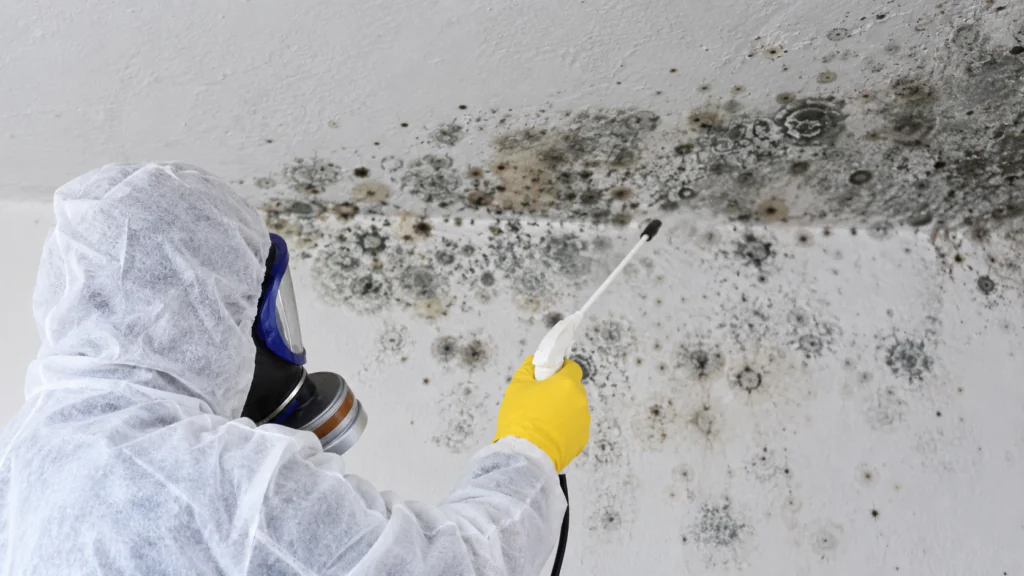
When removing mold, the treatment must be tailored to the material being treated. Wood, concrete, and other porous materials have a structure that allows them to absorb both moisture and liquid. This affects how a mold removal agent works and which properties are important when selecting a product and application method.
Why are porous materials different to treat?
Porous materials contain small voids and channels through which moisture can penetrate. Unlike a dense surface, therefore, treatment does not need to focus solely on the material’s surface.
The structure of the material, its absorbency, and the extent to which it has been affected are factors that must be taken into account during mold remediation. A treatment that acts primarily on the surface may have different properties than a product designed to penetrate the material.
Wood and concrete have different properties
Wood and concrete are two common porous building materials, but their properties differ. Even within the same type of material, conditions can vary depending on factors such as surface treatment, the condition of the material, and its moisture content.
This means that the remediation method must be based on the specific conditions at the site. Before treatment begins, it is necessary to assess, among other things, which material is to be treated, what type of growth is present, and what effect the treatment needs to have.
Penetration capacity can influence the choice of product
When treating a porous and absorbent material, the product’s ability to penetrate the substrate can be an important property.
Penetrox, for example, is designed for treating porous materials and has good penetrating power. The product can be used on materials such as wood and concrete to treat microbial growth.
Other cleaning agents may have properties that make them better suited when the treatment instead requires, for example, cleaning or other types of surface preparation. The choice should therefore be based on both the substrate and the desired outcome of the treatment.
The application method must be suitable for the job
The method of application is also influenced by on-site conditions. On accessible surfaces, direct application may be appropriate, while structures and hard-to-reach areas may require other methods.
For example, when applying sealant, the product is dispersed as small droplets in the air to reach surfaces in a larger or harder-to-reach area. However, not all products are designed for all application methods. Therefore, the product, the substrate, and the application method must all be taken into account.
Products for Professional Mold Removal
At Alron, you’ll find mold remediation products with various properties and applications for professional remediation work.
Do you need help choosing a product for wood, concrete, or other porous materials? Contact us at Alron, and we’ll help you find a product that’s right for the surface and the application.